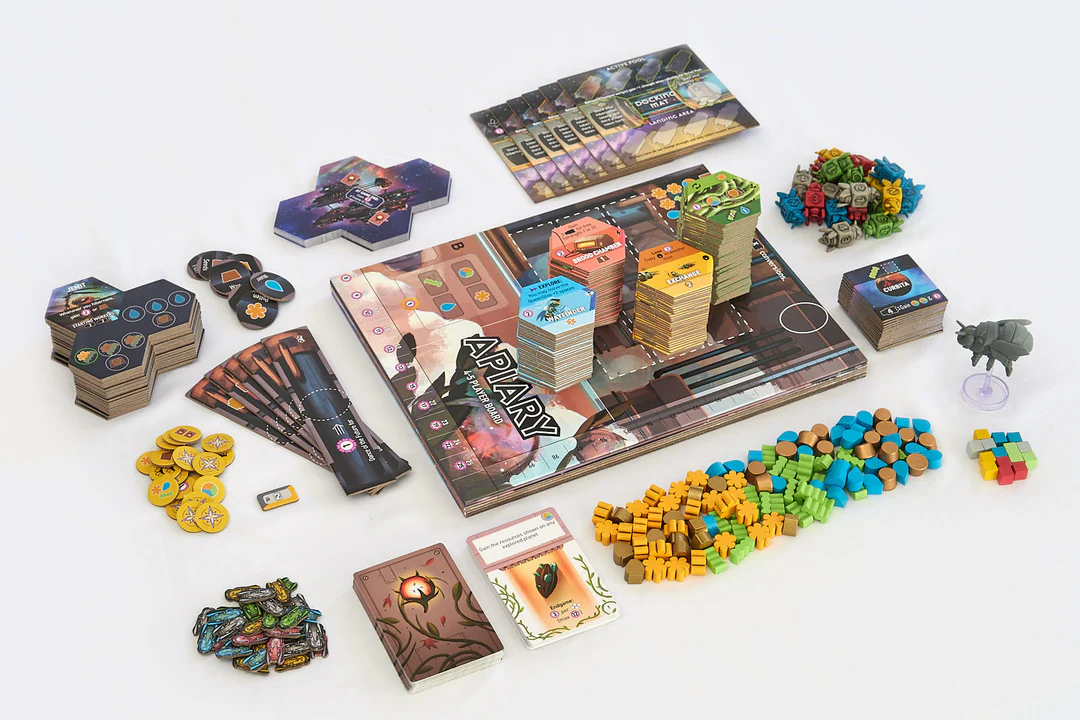
Apiary released in October 2023, between Wingspan and Wyrmspan. The discourse cycle gave it about six weeks. Reviewers noted correctly that the worker-aging system was clever and the no-turn-order design was novel. Then Wyrmspan announcements landed, Apiary slid out of the conversation, and the hobby moved on. Two and a half years later, it is still mechanically the most interesting worker placement Stonemaier has put out. Take 2023. The review is overdue, and overdue is the point.
Why Apiary disappeared
The release window did most of the damage. The Stonemaier marquee absorbs the oxygen in any Stonemaier discussion, and Apiary released between the two loudest releases in the publisher’s history. The community wanted Wingspan-but-more, and Apiary is not that. It is something different, and different is harder to talk about than “the same thing with dragons.”
Add a theme (space bees) that hobbyists either embrace in three seconds or write off in three seconds, and you get a game that quietly disappeared from the lists it should have led.
The first innovation: workers that age
Every other worker placement game treats workers as interchangeable tokens. Apiary’s workers start at strength 1 and gain a pip each time they return to your supply. Stronger workers can bump weaker ones off action spaces. When a worker hits strength 4, it retires and hibernates, granting a permanent benefit or end-game points.
The result is a worker pool constantly turning over. You are not just placing workers. You are managing a labor force across its lifecycle, deciding when to retire a strong worker for the long-term benefit and when to keep it on the board pushing other people around. Almost no other game in the genre asks this question.
The second innovation: no turn order, only recall timing
Apiary has no fixed turn order. You take a turn whenever you have workers to place. When you run out, you take a recall, pulling all workers back, aging them, and spending a full turn on the reset.
Players are constantly out of sync. One might be on their eighth action while another is on their fifth. This creates a strategic question unique to Apiary: when do you recall? Too early and you waste the action. Too late and you have burned tempo squeezing one last placement out of a thin pool. The recall is where Apiary’s game lives. The placement decisions are downstream of it.
What the combination does
Aging plus recall timing produces a worker placement game that asks better questions than its peers. Caverna asks you to optimize tile placement. Lords of Waterdeep asks you to draft quests. Wingspan asks you to build a tableau engine. All good questions.
Apiary asks “when does your labor force pivot,” which is a question worker placement games have been gesturing at for twenty years without committing to.
The case for Apiary is that it solves problems other worker placement games are still pretending do not exist.
What this should mean for the genre
The hobby calls Apiary “interesting” or “underrated” and then ranks Lords of Waterdeep or Viticulture above it. This is wrong. Apiary is the worker placement game that actually advanced the genre this decade. We should stop hedging.
The theme is still divisive, and the first play has a learning curve while the recall mechanic clicks into focus. Both of those are real. Neither of them is a reason to keep ranking lesser designs above it.
A successor worth naming
The genre has produced exactly one game since 2023 that meaningfully extends what Apiary started: Galactic Cruise (Kinson Key Games, 2025). It is heavy, intriguing, and satisfying, and the mechanical lineage is plain. When you launch a cruise, the workers crewing it leave the table and only return later, mid-game. Your worker pool fluctuates the same way Apiary’s does, out of sync with everyone else, never quite stable, always pushing you to decide when the next pivot happens. Reviewers comparing the two are right to. Apiary opened a door. Galactic Cruise walked through it.
The genre advanced in 2023. It advanced again in 2025. Most of us missed both. Now would be a good time to catch up.