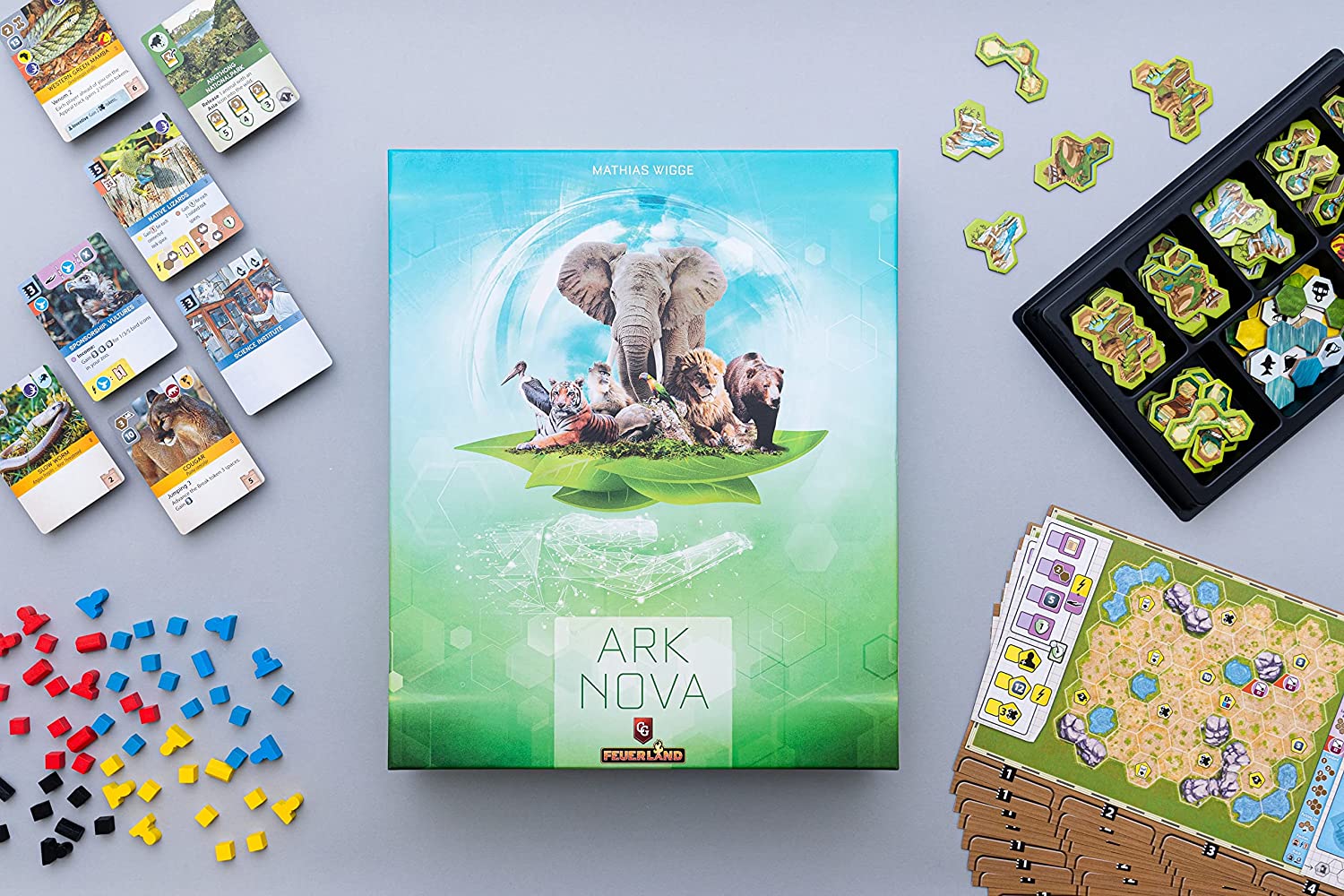
Your first game of Ark Nova ends with a zoo full of impressive animals and a Conservation Points marker that has barely moved. You finish with more Appeal than anyone at the table, less Conservation than anyone, and you lose. You walk away thinking you misread the strategy. You didn’t. You misread the math.
The shape of the game
Ark Nova ends when the two scoring markers cross. Appeal moves rightward, Conservation Points move leftward, and the gap between them at the moment they meet is what scores you the game.
The board shows you this. Two tracks moving toward each other on a shared scoreboard, one starting at each end. Most players see this layout and assume both tracks are interchangeable means to the same end. Push Appeal hard, push CP hard, whichever is more convenient on a given turn.
The tracks are not interchangeable. They are shaped differently, and you cannot tell from looking at them. One of them compounds, and one of them does not. That asymmetry is the whole game. It is also why so many first games end the same way: high Appeal, low Conservation, a loss, and the suspicion that something subtle was happening that you missed.
Why the Association compounds
The Association action is the entry point to three different systems: workers, reputation, and conservation points. You pick one per use, and each one compounds for the rest of the game.
A worker hired in round 2 is a worker available for nine more rounds. Workers return after being spent, so you reuse them on every cycle. Two workers in round 2 means twice as many things you can afford in rounds 3 through 11.
A reputation point earned in round 3 widens the card pool you can draft from for the rest of the game. Reputation gates which positions on the card market you can reach. Higher rep, more cards visible. Players who push rep through Association in rounds 1-3 are drafting from the middle and right of the market for the rest of the game. Players who don’t, won’t.
The CP arithmetic is the cleanest version. Donating at strength-4 Association in round 2 costs one action and scores you a meaningful chunk. The same CPs gained piecemeal at strength-2 Association in round 7 cost three actions. The compounding is not metaphorical. It is arithmetic.
This is what tempo means in Ark Nova. Action cards rotate constantly: each one you play drops to position 1 and the rest slide up. Tempo is whether your strong actions are firing on the systems that compound, or on the ones that do not.
Why the card draft compounds
Cards are options. Option depth in rounds 1-3 is option depth for the rest of the game. There is also a second-order effect. Your early cards shape what strategy you can pursue, because each card you draft is a constraint on what comes next. Draft narrowly in the first three rounds and you are committed to a single strategy by round 4. Draft broadly and you stay flexible until round 6.
Reputation makes this worse for late drafters. Without rep, your Cards action only reaches the leftmost positions on the market, which are cheap because they have weak abilities, high costs, and small payoffs. The card market is sorted by quality, and reputation is the key that unlocks the better positions.
A strong card hand also feeds back into Association. Many projects and donations require specific cards. Without depth, you cannot complete projects. Without rep, you cannot reach the cards that let you complete projects. The two systems lift each other, and either one falling behind drags the other.
Why Appeal does not compound
Appeal is a transaction. You play an animal, you gain Appeal, you move forward. Per play, per card, linear. There is no engine on the Appeal side of the board. There is only a sequence of plays, each one paid for in cards and money and action strength.
There is some weak compounding to acknowledge. A handful of animals trigger when other animals are played. Some Break thresholds reward high Appeal positions. None of it changes the underlying shape. Appeal is something you spend resources to score. CP is something an engine produces for you.
Appeal points are bought. Conservation points are harvested.
The Appeal-focused player feels productive throughout the game. Animals on the table, things happening, scoreboard ticking. The CP-focused player feels slow. Three turns of setup, then a donation that scores six points, then more setup. The math says the CP player is ahead. The Appeal player just has not realized it yet.
Ark Nova does not have a strictly dominant strategy. The card market shifts every game, your starting cards are variable, and sometimes Appeal is the right call because the right cards are in front of you. The principle is not “always push CP.” The principle is “know which track compounds before you decide which to push.”
What this means for the first three rounds
In rounds 1-3, you are not playing for points. You are building the system that will score points later.
Cards and Association first. Build and Animals second.
One strong opening pattern: Cards first, while its action strength is highest. You draw more cards than you ever will again. Association second, for reputation and a worker. By round 3, your hand has depth and your engine has a foundation. Now Animals can fire if you have a strong reason to play. If not, Cards or Association can run again.
That is one pattern. The right opening always depends on the cards in play. But the shape holds: invest, then convert.
The most common new-player mistake in Ark Nova is opening with a Build or an Animal play because the table is empty and the impulse is to fill it. Resist this. An empty zoo board in round 1 is not a problem. An empty hand in round 5 is a problem, and it was created by the round 1 decision to spend your strongest action card on something else.
If you opened your last game by playing animals from your starting hand, you played the game wrong. Not because the animals were bad. Because the action card slot was.
The math is on the board
The hidden math is not actually hidden. It is printed on the board. Two tracks, moving toward each other, with very different shapes. Appeal is a sequence of transactions. Conservation is the output of an engine. The game shows you the math.
Most players just refuse to read it.